

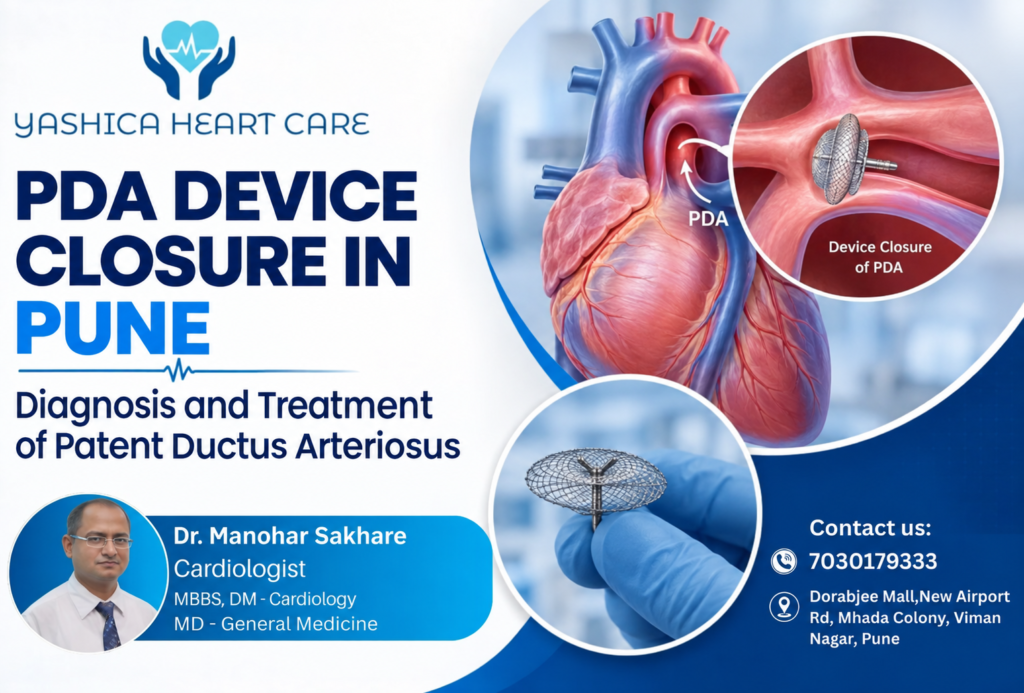
PDA Device Closure in Pune: Diagnosis and Treatment of Patent Ductus Arteriosus
PDA Device Closure in Pune is a minimally invasive procedure used in selected patients with Patent Ductus Arteriosus, a condition in which a blood vessel called the ductus arteriosus remains open after birth. Depending on its size and the patient’s age and overall health, a PDA may cause no symptoms or may place additional strain on the heart and lungs. Patent Ductus Arteriosus is more commonly identified in children, although some adults may also have an undiagnosed PDA. Evaluation usually involves understanding the patient’s symptoms, medical history, physical examination, and cardiac imaging. When closure is considered appropriate, a cardiologist can assess whether a catheter-based device closure or another treatment approach is suitable. What Is Patent Ductus Arteriosus? Patent Ductus Arteriosus, commonly called PDA, is a congenital heart condition involving the ductus arteriosus. During fetal development, this blood vessel connects the pulmonary artery to the aorta and allows blood to bypass the developing lungs. Normally, the ductus arteriosus closes after birth as the baby’s circulation changes. If it remains open, blood can flow between the aorta and pulmonary artery. The effect of a PDA depends on its size and the amount of blood passing through it. A small PDA may not cause noticeable symptoms, while a larger PDA can increase blood flow to the lungs and place additional workload on the heart. An evaluation can help determine the size and significance of the PDA and whether observation, medical management, catheter-based closure, or another intervention may be appropriate. What Causes Patent Ductus Arteriosus? PDA develops because the ductus arteriosus does not close completely after birth. The exact reason why this happens can vary. Factors associated with PDA may include: Premature birth Low birth weight Certain genetic conditions Congenital heart conditions Maternal infections during pregnancy Other developmental factors PDA is a congenital condition, meaning it is related to the structure of the heart and blood vessels present from birth. Not every person with a PDA will experience symptoms or require closure. The decision depends on the characteristics of the PDA and its effect on the heart and circulation. Signs and Symptoms of PDA The symptoms of Patent Ductus Arteriosus can vary depending on the size of the opening and the amount of blood flowing through it. Possible symptoms may include: Rapid breathing Difficulty feeding in infants Poor weight gain Easy tiring Shortness of breath Fast heartbeat Sweating during feeding Recurrent respiratory problems Reduced exercise tolerance A small PDA may produce no obvious symptoms and can sometimes be discovered during an examination for another reason. In some cases, a doctor may hear an unusual heart sound or murmur during a routine examination, leading to further cardiac testing. Symptoms alone cannot determine whether a PDA is present or whether closure is necessary. Cardiac imaging is generally required to understand the condition. When Should You See a Specialist? A Cardiologist in Pune may be consulted when a child or adult has symptoms suggestive of a congenital heart condition or when a PDA has already been identified. A cardiac evaluation may be appropriate if: A heart murmur has been detected An echocardiogram suggests PDA A child has unexplained breathing difficulty An infant has difficulty feeding or gaining weight There is unexplained tiredness There is reduced exercise tolerance A congenital heart condition has previously been diagnosed A previous cardiac report requires further evaluation A specialist can review the patient’s history and imaging reports to determine whether the PDA requires observation, further investigation, or closure. Understanding PDA in Pune People searching for PDA in Pune may have questions after an echocardiogram identifies Patent Ductus Arteriosus. A PDA report should be understood in relation to its size, blood flow, pressure in the pulmonary arteries, and the effect on the heart. A doctor may review the echocardiogram, symptoms, oxygen levels, blood pressure, medical history, and other cardiac findings. In children, growth, feeding, breathing, and activity levels may also be considered. In adults, exercise tolerance and any associated cardiac conditions can be relevant. Not every PDA requires immediate closure. Some small PDAs may be monitored, while other cases may require intervention to prevent or manage potential complications. About Dr. Manohar Sakhare Patil Dr. Manohar Sakhare Patil is a Consultant Cardiologist and Interventional Cardiologist practicing in Pune, with more than 22 years of experience in cardiology. He completed his MBBS from Government Medical College, Nagpur, in 1997. He subsequently joined the Medicine Department at AIIMS, New Delhi, and completed his MD in Internal Medicine in 2001. He then completed his DM in Cardiology from AIIMS, New Delhi, in 2005. After completing his cardiology training, he worked as a junior consultant in the Department of Cardiology at Sri Sathya Sai Institute of Higher Medical Sciences, Bengaluru, from December 2006 to July 2008. During this period, his professional experience included a range of interventional cardiology procedures, including PTCA, BMV, pacemaker procedures, AICD procedures, pediatric interventions, and carotid and peripheral interventions. He later worked as an interventional cardiologist at Inlaks & Budhani Hospital, Pune, from August 2008 to October 2013. During this period, his work included coronary interventions and other interventional cardiology procedures. He currently practices as an independent interventional cardiologist in Pune and has a clinic in Viman Nagar. His professional profile states that he has performed more than 8,000 PTCA procedures through the radial route, including complex angioplasty procedures such as PAMI, bifurcation, and multivessel PTCA. His professional background also includes experience with pediatric interventions and device-based procedures, which are relevant areas of interventional cardiology. Qualification: MBBS, MD – Internal Medicine, DM – Cardiology Specialty: Cardiologist and Interventional Cardiologist Experience: 22+ Years Location: Viman Nagar, Pune Tests Used to Diagnose PDA Several cardiac investigations may be used to identify Patent Ductus Arteriosus and understand its effect on the heart. Echocardiography An echocardiogram is one of the main investigations used to evaluate PDA. It uses ultrasound to examine the heart’s structure and blood flow. It can provide information about: The presence of PDA Approximate size of the PDA Direction of blood flow Heart chamber