

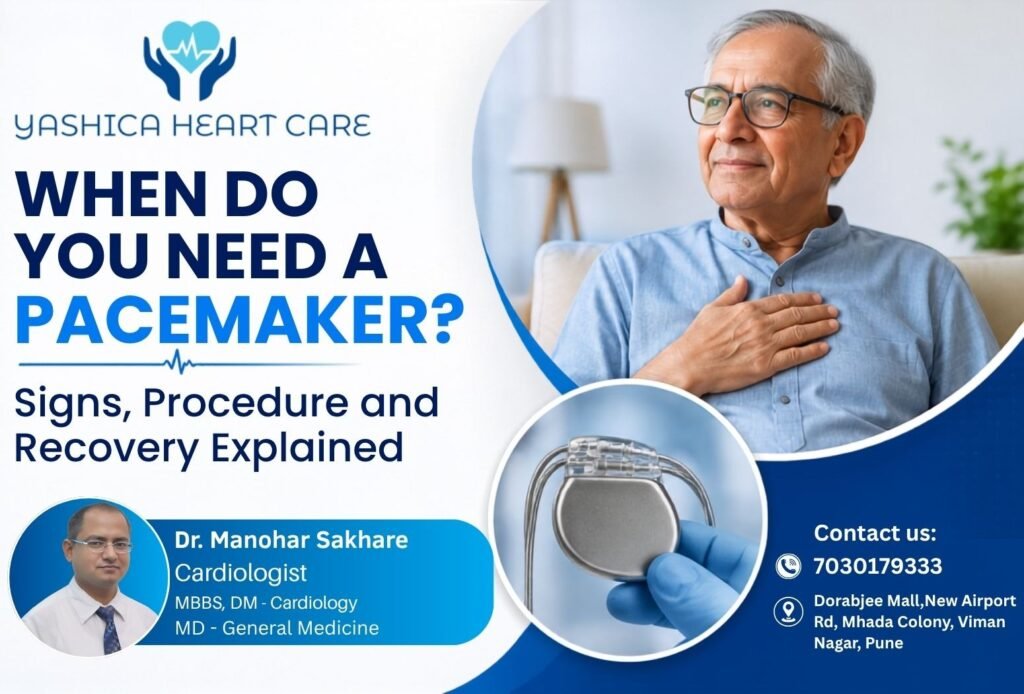


A pacemaker is a small medical device that helps regulate an abnormally slow or irregular heartbeat. For patients with certain heart rhythm and electrical conduction problems, Pacemaker Implantation in Pune may be recommended to maintain an appropriate heart rate and reduce symptoms such as dizziness, fainting, fatigue, or breathlessness.
If you have been diagnosed with a slow heartbeat, heart block, or another electrical conduction problem, timely evaluation by an experienced cardiologist can help determine whether you need a pacemaker.
At Yashica Heart Care Centre, Viman Nagar, Pune, Dr Manohar Sakhare Patil provides comprehensive cardiac evaluation and advanced treatment for patients with heart rhythm problems.
With more than 22+ years of experience and 8,000+ successful angioplasty procedures, Dr Manohar Sakhare Patil offers personalized cardiac care based on each patient’s condition and treatment needs.
What Is a Pacemaker?
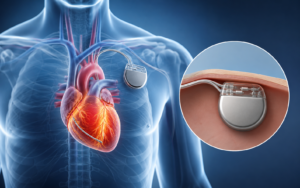
A pacemaker is a small electronic device designed to help regulate the heartbeat when the heart’s natural electrical system is unable to maintain an appropriate rhythm.
A pacemaker generally consists of:
- Pulse generator: A small battery-powered device that produces electrical impulses.
- Leads: Thin wires that carry electrical signals to the heart.
When the heart beats too slowly or certain electrical signals are blocked, the pacemaker can send electrical impulses to help maintain an appropriate heart rate.
However, not everyone with a slow heartbeat requires a pacemaker. The need for treatment depends on the patient’s symptoms, ECG findings, type of rhythm problem, medical history, and overall health.
When Do You Need Pacemaker Implantation in Pune?
Pacemaker Implantation in Pune may be recommended when the heart’s electrical system cannot maintain an adequate heart rate or when a conduction problem causes significant symptoms.
Common conditions that may require a pacemaker include:
Slow Heart Rate or Bradycardia
Bradycardia means that the heart is beating slower than expected.
A slow heart rate does not always require treatment. However, if it causes symptoms such as dizziness, fainting, fatigue, breathlessness, or reduced exercise tolerance, a cardiologist may recommend further evaluation.
Heart Block
Heart block occurs when electrical signals travelling through the heart are delayed or blocked.
Depending on the type and severity of heart block, pacemaker treatment may be recommended to maintain a reliable heartbeat.
Sick Sinus Syndrome
The sinus node is the heart’s natural pacemaker. When it does not work properly, the heart may beat too slowly, pause, or alternate between slow and fast rhythms.
Patients with significant symptoms may require pacemaker treatment.
Certain Heart Rhythm Problems
Some heart rhythm conditions or their treatments can result in an excessively slow heart rate. In selected cases, a pacemaker may help maintain a stable rhythm.
Signs You May Need a Pacemaker
Some patients with electrical conduction problems may have no symptoms initially. Others may experience noticeable changes in their health.
Important symptoms include:
Persistent Dizziness
Repeated dizziness or light-headedness can occur when a slow heartbeat reduces the amount of blood reaching the brain.
Fainting or Near-Fainting
Unexplained fainting should always be evaluated, particularly if it occurs along with a slow heart rate or abnormal ECG.
Unusual Fatigue
Persistent tiredness despite adequate rest can sometimes be associated with a slow heart rhythm.
Shortness of Breath
Breathlessness during routine activities may occur when the heart cannot maintain an adequate rate.
Palpitations
A sensation of skipped beats, fluttering, or an irregular heartbeat should be discussed with a cardiologist.
Reduced Exercise Tolerance
If activities that were previously easy suddenly become difficult, an underlying heart rhythm problem may need to be investigated.
Chest Discomfort
Chest discomfort can have several causes, including serious heart conditions. New or severe chest pain requires prompt medical evaluation.
How Is the Need for a Pacemaker Diagnosed?
Before recommending Pacemaker Implantation in Pune, a cardiologist performs a detailed evaluation.
Tests may include:
Electrocardiogram (ECG)
An ECG records the electrical activity of the heart and can detect slow heart rates and conduction abnormalities.
Holter Monitoring
A Holter monitor continuously records the heart rhythm, usually for 24 hours or longer. It can detect intermittent rhythm problems that may not appear during a routine ECG.
Extended Heart Rhythm Monitoring
For patients whose symptoms occur occasionally, longer monitoring may help identify abnormal heart rhythms.
Echocardiography
An echocardiogram uses ultrasound to examine the structure and function of the heart.
Blood Tests
Blood tests may help identify reversible causes of abnormal heart rhythms, including certain thyroid or electrolyte abnormalities.
Medical History and Clinical Evaluation
The cardiologist will also review medications, existing heart conditions, previous procedures, symptoms, and other risk factors before recommending treatment.
Pacemaker Implantation in Pune – How Is the Procedure Performed?
If a pacemaker is considered appropriate, the cardiologist will explain the procedure, expected benefits, possible risks, and recovery process.
Pacemaker Implantation in Pune is generally performed in a hospital or specialized cardiac facility.
The procedure commonly involves the following steps:
1. Patient Preparation
The medical team reviews your medical history, medications, allergies, investigations, and general health before the procedure.
2. Local Anaesthesia
The implantation area is usually numbed with local anaesthesia. Sedation may also be used depending on the patient’s condition.
3. Small Incision
A small incision is generally made below the collarbone.
4. Lead Placement
Thin leads are guided through a blood vessel toward the appropriate chamber or chambers of the heart.
5. Generator Placement
The leads are connected to the pulse generator. The generator is usually positioned under the skin near the upper chest.
6. Device Testing
The pacemaker is tested to ensure that it is sensing and pacing the heart appropriately.
7. Closing the Incision
Once the device placement is confirmed, the incision is closed and the patient is monitored.
The exact technique may vary depending on the patient’s condition and the type of pacemaker required.
Is Pacemaker Implantation Safe?
Pacemaker implantation is a commonly performed cardiac procedure. However, like every medical procedure, it can have potential risks.
Possible complications include:
- Bleeding or bruising
- Infection
- Blood vessel injury
- Lead displacement
- Pneumothorax
- Device-related complications
- Rare heart-related complications
Before Pacemaker Implantation in Pune, your cardiologist will explain the potential benefits and risks based on your individual health condition.
What Happens After Pacemaker Implantation?
After the procedure, the medical team monitors your heart rhythm and checks the pacemaker.
Some patients may be discharged after a period of observation, while others may require longer monitoring depending on their health and the reason for implantation.
Mild soreness, bruising, or discomfort around the implantation site can occur during the initial recovery period.
Your cardiologist will provide instructions regarding:
- Wound care
- Medicines
- Physical activity
- Follow-up appointments
- Device monitoring
- Warning signs to watch for
Pacemaker Recovery in Pune – What Should You Expect?
Recovery after Pacemaker Implantation in Pune varies from patient to patient.
During the initial recovery period, patients are generally advised to:
- Keep the incision clean and dry as instructed
- Take prescribed medicines regularly
- Attend scheduled follow-up appointments
- Avoid strenuous physical activity until cleared
- Follow instructions regarding arm and shoulder movement
- Report redness, swelling, fever, or discharge
- Keep pacemaker identification information accessible
Your cardiologist will advise you when you can safely return to normal activities.
How Long Does a Pacemaker Last?
Modern pacemakers are designed to function for many years. However, the battery eventually needs replacement.
Battery life depends on several factors, including:
- How frequently the pacemaker is used
- Device type
- Pacing settings
- Individual heart rhythm requirements
- Overall device usage
Regular follow-up helps doctors monitor the pacemaker and battery status.
When the battery becomes low, the generator can generally be replaced without replacing the entire system.
What Are the Benefits of a Pacemaker?
For patients who genuinely require pacing support, a pacemaker can provide important benefits.
These may include:
- Maintaining an appropriate heart rate
- Reducing symptoms associated with slow heart rhythms
- Improving exercise tolerance in suitable patients
- Reducing episodes of dizziness or fainting caused by bradycardia
- Supporting treatment of certain conduction disorders
- Improving quality of life
The benefits depend on the underlying heart rhythm problem and the patient’s overall health.
Pacemaker vs ICD – Are They the Same?
A pacemaker and an Implantable Cardioverter Defibrillator (ICD) are different devices.
A pacemaker primarily helps manage certain slow heart rhythms by providing electrical stimulation when required.
An ICD can monitor heart rhythm and deliver an electrical shock when certain dangerous fast rhythms occur. Some ICDs also have pacing capabilities.
Therefore, the appropriate device depends on the patient’s specific heart condition.
When Should You Consult a Cardiologist in Pune?
You should consider a cardiac evaluation if you experience:
- Repeated dizziness
- Unexplained fainting
- Persistent fatigue
- Breathlessness
- Palpitations
- Reduced exercise tolerance
- Known slow heart rate
- Diagnosed heart block
- Abnormal ECG findings
- A history of heart rhythm problems
Timely consultation with a cardiologist in Pune can help identify the underlying cause and determine whether treatment is required.
If you experience severe or sudden chest pain, severe difficulty breathing, fainting, or other symptoms of a possible heart emergency, seek emergency medical care immediately.

Advanced Cardiac Care at Yashica Heart Care Centre, Pune
At Yashica Heart Care Centre, Viman Nagar, Pune, Dr Manohar Sakhare Patil provides comprehensive cardiac evaluation and treatment.
His cardiac services include:
Pacemaker Implantation in Pune
Evaluation and treatment for patients who may require pacing support because of specific heart rhythm or conduction disorders.
Cardiac Consultation
Detailed evaluation of symptoms, risk factors, medical history, and cardiovascular health.
Coronary Angiography
Diagnostic evaluation to identify blockages in the coronary arteries.
Coronary Angioplasty
Minimally invasive treatment for selected patients with significant coronary artery blockages.
Radial Angioplasty
A wrist-based approach used for selected coronary interventions.
Preventive Cardiology
Assessment and management focused on reducing future cardiovascular risks.
Heart Rhythm Evaluation
Evaluation of symptoms such as palpitations, dizziness, fainting, and abnormal heart rates.
Why Choose Dr Manohar Sakhare Patil for Pacemaker Treatment in Pune?
Choosing the right cardiologist is important when you have a heart rhythm disorder or may require a pacemaker.
Patients choose Dr Manohar Sakhare Patil because of:
- 22+ years of cardiology experience
- AIIMS New Delhi training
- 8,000+ successful angioplasty procedures
- Expertise in interventional cardiology
- Experience managing complex cardiac conditions
- Comprehensive cardiac evaluation
- Personalized treatment planning
- Preventive cardiology expertise
- Patient-focused cardiac care
Patients looking for Pacemaker Implantation in Pune can consult Dr Manohar Sakhare Patil at Yashica Heart Care Centre for appropriate evaluation and treatment planning.
Yashica Heart Care Centre, Viman Nagar, Pune
Dr Manohar Sakhare Patil practices at:
Yashica Heart Care Centre, Viman Nagar, Pune
The centre provides comprehensive cardiac care, including:
- Cardiac consultations
- Heart disease screening
- Pacemaker evaluation and treatment
- Coronary angiography
- Coronary angioplasty
- Radial angioplasty
- Preventive cardiology
- Heart rhythm evaluation
- Cardiovascular risk management
Patients from Viman Nagar, Kharadi, Wagholi, Lohegaon, Vishrantwadi, Yerawada, and nearby areas of Pune can seek expert cardiac evaluation.
Benefits of Early Heart Rhythm Evaluation
Early evaluation of unexplained cardiac symptoms can help:
- Identify rhythm problems
- Detect conduction abnormalities
- Understand the cause of dizziness or fainting
- Assess heart function
- Identify treatable risk factors
- Prevent complications in appropriate patients
- Choose suitable treatment at the right time
A pacemaker is not necessary for everyone with a slow heartbeat. However, when a significant electrical conduction problem is diagnosed, timely treatment can make an important difference.
Summary
A pacemaker may be recommended for patients with certain slow heart rhythms, significant pauses, or heart block.
Symptoms such as dizziness, fainting, unusual fatigue, breathlessness, palpitations, and reduced exercise tolerance should not be ignored.
A detailed cardiac evaluation can help determine whether Pacemaker Implantation in Pune is appropriate for your condition.
Patients requiring specialized heart rhythm evaluation can consult Dr Manohar Sakhare Patil at Yashica Heart Care Centre, Viman Nagar, Pune, for personalized cardiac care.
FAQs – Pacemaker Implantation in Pune
When do you need a pacemaker?
A pacemaker may be recommended for certain slow heart rhythms, significant pauses, or types of heart block that cause symptoms or create a significant health risk.
What are the signs that you may need a pacemaker?
Common symptoms include dizziness, fainting, unusual fatigue, breathlessness, palpitations, and reduced exercise tolerance. These symptoms can have many causes, so proper cardiac evaluation is important.
Where can I get Pacemaker Implantation in Pune?
Patients requiring pacemaker evaluation and treatment can consult Dr Manohar Sakhare Patil at Yashica Heart Care Centre, Viman Nagar, Pune.
Is Pacemaker Implantation in Pune a major surgery?
Pacemaker implantation is generally performed through a small incision near the upper chest. The exact procedure and recovery depend on the patient’s medical condition and the type of device required.
How long does it take to recover after Pacemaker Implantation in Pune?
Recovery varies between patients. Many people gradually return to normal activities after following their cardiologist’s instructions.
How long does a pacemaker last?
Pacemaker battery life varies depending on the device and how frequently it is used. Regular follow-up helps monitor battery life and device function.
Can a person live a normal life with a pacemaker?
Many patients with pacemakers return to their normal daily activities after recovery. Your cardiologist can provide personalized guidance based on your health and device.
Is a pacemaker the same as an ICD?
No. A pacemaker primarily treats certain slow heart rhythms, while an ICD is designed to detect and treat certain dangerous fast heart rhythms.
Conclusion – Pacemaker Implantation in Pune
Pacemaker Implantation in Pune can be an important treatment for patients with specific heart rhythm and electrical conduction problems.
Symptoms such as unexplained fainting, persistent dizziness, unusual fatigue, breathlessness, or a known slow heartbeat should be evaluated by an experienced cardiologist.
Dr Manohar Sakhare Patil, with 22+ years of cardiology experience and extensive expertise in interventional cardiology, provides comprehensive cardiac evaluation and treatment at Yashica Heart Care Centre, Viman Nagar, Pune.
If you have been advised to consider a pacemaker or are experiencing symptoms of a slow or irregular heartbeat, timely consultation can help identify the cause and determine the most appropriate treatment for your condition.